

You can cross the US and Mexico border by bicycle at Laredo. Southbound, you need a passport and an FMM tourist permit (983 MXN in 2026, about $54 USD, and free for stays of seven days or less by land), and you have to walk into the INM office yourself to get it stamped. Northbound, US citizens need a passport. Most other riders need an ESTA or a B2 visa plus a land border I-94, which costs $30. The bigger question is the route. Nuevo Laredo is in Tamaulipas, which the US State Department rates Level 4, “Do Not Travel.” So most of the planning is about minimizing time there and getting into Nuevo León, which is rated Level 2. Once you reach Monterrey, budget rooms run about 400 to 600 MXN, and food at an OXXO or a comedor is cheap and everywhere.
Key takeaways
- Southbound: passport plus FMM. Get it stamped at INM yourself. Nobody will send you there.
- Visa: most nationalities, including US, Canadian, UK, and EU citizens, don’t need a visa for Mexico. Check with a Mexican consulate if you’re from somewhere else.
- Northbound: passport for US citizens. For everyone else, ESTA or a B2 visa, plus a $30 land border I-94.
- Bridge: Bridge I (Gateway to the Americas) in downtown Laredo is open to pedestrians around the clock, and CBP has processed bicycles there.
- Safety: Tamaulipas is Level 4 and Nuevo León is Level 2. Ride in daylight, don’t linger in Nuevo Laredo, and consider a bus for that stretch.
- Sleeping: budget hotels 400 to 600 MXN. For camping, ask first at ranches, restaurants, churches, and fire stations (bomberos).
- Food: OXXO for water and snacks, comedores for a comida corrida lunch at 50 to 100 MXN.
What is in this guide
- What documents do you need to cycle into Mexico?
- Which Laredo bridge can you cross on a bike?
- What do you need to cross back into the US on a bike?
- Is it safe to cycle through Tamaulipas?
- Which route should you take to Monterrey?
- Where can you camp, and where should you not?
- How much do hotels and motels cost?
- Where do you get food on the road?
- What should you do in Monterrey?
- FAQ
I live in Monterrey and host touring cyclists through Warmshowers, usually a few a year. Almost every one of them has asked me some version of the questions below, so here are my answers in one place.
What documents do you need to cycle into Mexico?
You need a valid passport and an FMM (Forma Migratoria Múltiple), Mexico’s tourist permit. Most nationalities, including US, Canadian, UK, and EU citizens, don’t need a visa. If you’re not sure about your passport, check with a Mexican consulate before you ride.
The FMM costs 983 MXN in 2026, about $54 USD. It’s free if you’ll be in Mexico seven days or less. You can pay online through INM before you go, print it, and present it at the border. It allows up to 180 days, but the officer decides how many you get, so tell them your plan. Long tours need the full 180.
The mistake every cyclist makes: at a land crossing, nobody stops you and nobody points you to immigration. You can ride straight into Mexico without an entry stamp. Don’t. Find the INM office at the bridge and get the FMM stamped. Without the stamp you’re technically in the country illegally, which catches up with you at the next checkpoint or when you leave.
Which Laredo bridge can you cross on a bike?
Bridge I (Gateway to the Americas) in downtown Laredo is the one set up for people on foot. It’s open to pedestrians 24 hours, and CBP has processed northbound pedestrian and bicycle traffic there. The toll for walkers is $1 southbound and 5 MXN northbound, and bikes are generally charged like pedestrians. Laredo’s bridge tolls go up starting January 1, 2027.
The Colombia Solidarity Bridge, about 20 miles northwest of Laredo, has pedestrian walkways and crosses straight into Nuevo León. That skips Tamaulipas entirely. Its car hours are 8 a.m. to midnight. I haven’t confirmed that cyclists can use it, so ask at the US side before committing to the extra miles.
What do you need to cross back into the US on a bike?
US citizens just need a passport. For everyone else:
- Visa Waiver countries (most of Europe, the UK, Australia, and others) don’t need an ESTA to enter by land. You’ll get a land border I-94, which has cost $30 since September 30, 2025. You can start it in the CBP Home app, which replaced CBP One for this, but then you need an ESTA and must show up at the border within seven days.
- Non-Visa Waiver countries need a B2 tourist visa.
Hand in your FMM at INM on the Mexican side before you cross north.
Is it safe to cycle through Tamaulipas?
This is the question I get the most, and I’ll be straight: it’s the part of the route I’d minimize. In its May 29, 2026 update, the US State Department rated Tamaulipas Level 4, “Do Not Travel,” and the advisory specifically names the border from Reynosa to Nuevo Laredo. Nuevo León is Level 2, “Exercise Increased Caution.” Monterrey is in Nuevo León.
What that means in practice:
- Don’t plan the Gulf coast route through Tamaulipas. It’s hundreds of kilometers inside the Level 4 state.
- From Laredo, go straight for Nuevo León. If you can cross at Colombia, you never enter Tamaulipas. If you cross at Nuevo Laredo, ride out of town in the morning and keep moving.
- Or take the bus for that stretch. Buses run from Nuevo Laredo to Monterrey. Ask the bus line about bikes before you buy. A few hours on a bus in exchange for starting fresh in Monterrey is a trade I’d take.
- Ride in daylight only, everywhere in the north. The advisory’s general guidance is to avoid traveling between cities after dark.
- Expect a federal checkpoint at Km 26 south of Nuevo Laredo. Keep your passport and stamped FMM handy.
Which route should you take to Monterrey?
Southbound from Laredo, most riders head for Monterrey and then on toward Saltillo. On federal highways, Mexican rules put cyclists on the shoulder, or in the right lane where there isn’t one. The toll roads (cuotas) usually have wide shoulders. There’s no clear national rule banning bikes from cuotas, but some have “no bikes” signs, so read the signs where you get on.
After Monterrey, the common options are:
- West to Saltillo, then south. Be ready for Highway 57 south of Saltillo. It’s a long two-lane stretch with heavy truck traffic.
- South toward San Luis Potosí and La Huasteca Potosina, for waterfalls and rivers.
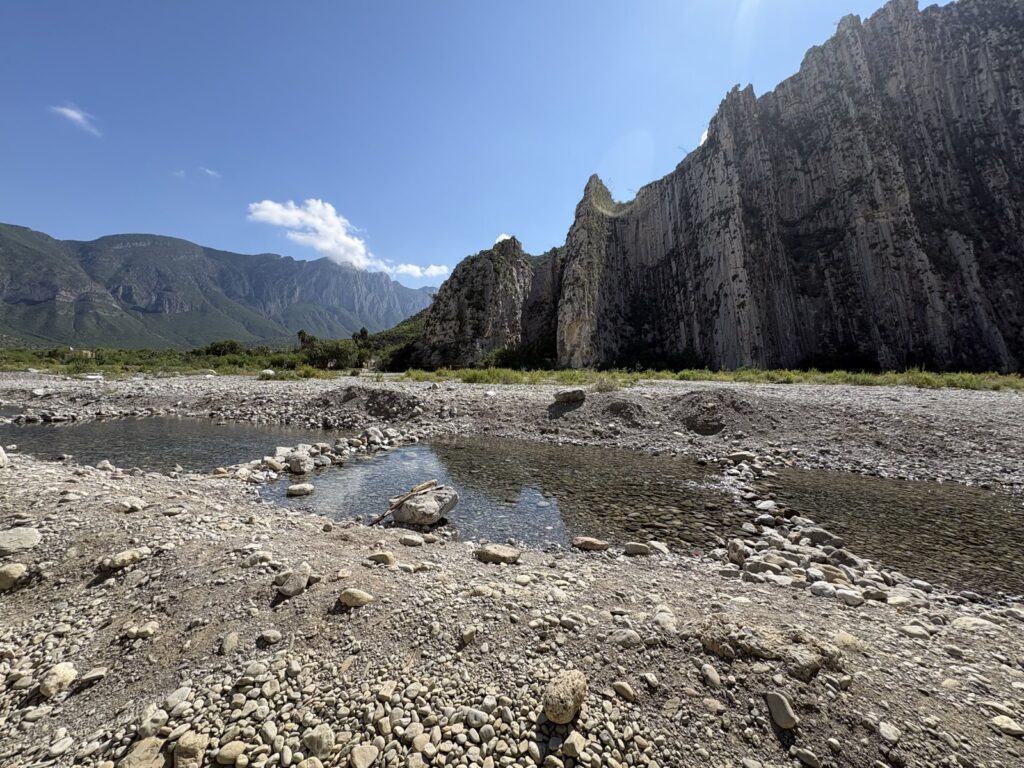
Worth a detour near Monterrey: El Potrero Chico, about 25 miles northwest, has camping and a winter crowd of climbers. The hot springs at La Azufrosa and San Joaquín are about 55 km west of Potrero Chico in the Coahuila desert, with no stores nearby, so carry food.
Where can you camp, and where should you not?
Ask first, every time. Small restaurants, ranchers, churches, and fire stations (bomberos) usually say yes to a cyclist with a tent. Someone who knows you’re there is looking out for you. That’s the whole point of asking.
My own rules of thumb in northern Mexico:
- Unfenced land with no sign is generally fine for a quiet night. A fence, a gate, or a sign means it belongs to someone, so ask.
- Gas stations and OXXOs work in a pinch. Buy something, ask if you can sleep a few hours, and ask where they want you. The best spot is usually under a light near the store.
- Don’t wild camp in Tamaulipas, and don’t pitch a tent anywhere visible from a highway.
- In Monterrey, don’t camp in the city. Use a hotel, a hostel, or a Warmshowers host.
How much do hotels and motels cost?
Budget doubles in northern Mexico usually run about 400 to 600 MXN a night. Cheaper rooms exist in small towns, and campgrounds run 100 to 200 MXN. The roadside “love hotels” (auto hotels) you’ll see on the edge of towns are a legitimate option. They’re cheap and usually clean.
Where do you get food on the road?
- OXXO. There’s one in nearly every town. Water, electrolytes, snacks, and a bathroom. Snacks run about 20 to 100 MXN.
- Comedores and fondas. Look for a comida corrida, a set lunch of soup, a main, tortillas, and a drink. It costs 50 to 100 MXN and is the best-value fuel in the country.
- Tienditas. The small corner shops in every village, for when there’s no OXXO.
- Carry more water than you think on the desert stretches west of Monterrey.
What should you do in Monterrey?
Take a rest day or three. Monterrey is a big city ringed by mountains, and there’s plenty to do off the bike. My picks:
- Parque Fundidora and the Paseo Santa Lucía. A huge park built on an old steelworks, connected to the Macroplaza by a riverwalk. It’s flat, so it’s a good easy spin on a rest day.
- Barrio Antiguo. The old quarter, for food and nightlife.
- Chipinque. The mountain park above the city. If your legs still want more, La Eme is one of the hardest hikes here.
- Grutas de García. Caves reached by a cable car, an easy half day from the city.
- La Huasteca. Big limestone walls just west of town, and Pico Horcones if you want a summit.
FAQ
Do I need a visa to cycle into Mexico?
Not if you’re from the US, Canada, the UK, or the EU. You need a passport and an FMM tourist permit. Other nationalities should check with a Mexican consulate.
How much is the FMM in 2026?
983 MXN, about $54 USD. It’s free for stays of seven days or less by land.
Can I ride a bicycle across the Laredo bridge?
Bridge I (Gateway to the Americas) is open to pedestrians 24 hours, and CBP has processed bicycles there. Pedestrians pay $1 going south.
How much is the I-94 at a land border?
$30, since September 30, 2025.
Can bicycles ride on Mexican toll roads?
There’s no clear national ban. Federal rules put cyclists on the shoulder, but some toll roads post “no bikes” signs.
How much is a cheap hotel in northern Mexico?
Budget doubles usually cost about 400 to 600 MXN a night.
Planning a long ride through Mexico? Get my free Go Fearless: The Expat and Solo Travel Toolkit.



0 Comments