


North Beach, Maryland is a former rail resort on the Chesapeake Bay that is better in the off season than in summer. The crowds left in the 1950s, the winter storms are what expose the fossil shark teeth in the beach gravel, and dogs can get on the sand once the summer season ends. I went in March with a friend and a dog, and it made the case for itself.
Key takeaways
- North Beach was platted in 1900 as “North Chesapeake Beach,” part of a rail resort boom that put the first trains in from Washington and Baltimore in June 1900.
- Two events killed the resort economy: the Chesapeake Bay Bridge in 1952, which sent drivers to the Atlantic instead, and Maryland’s repeal of the gambling statute in 1968.
- The beach gravel here carries Miocene fossils 10 to 20 million years old. Over 600 fossil species have been identified from the Calvert Cliffs deposits, including megalodon, mako, sand tiger and hammerhead teeth.
- Winter is the better fossil season, because storm erosion is what exposes fresh material. Low tide a day or two after rough weather beats a July afternoon on a picked-over beach.
- In season the beach charges $9 for Calvert County residents and $25 out of county. Off season it is free, empty, and open to dogs.
What’s in this guide
- A town built for crowds that stopped coming
- Why is the off season the better trip?
- Finding shark teeth on the Chesapeake
- The oyster reef next door
- Can you bring a dog to North Beach?
- Where do you park, and what does it cost?
- Practical details: fees, pier, museum, food
- Common questions
A town built for crowds that stopped coming
North Beach is a small Chesapeake Bay town in northern Calvert County, Maryland, that was purpose-built as a summer resort and then spent seventy years quietly not being one. It sits about thirty miles south of Annapolis and one mile north of Chesapeake Beach.
It was laid out in 1900, originally as “North Chesapeake Beach.” That name came from what was happening one mile south, where Otto Mears was building Chesapeake Beach as a full destination resort reachable by rail. The first trains came down from Washington and Baltimore in June 1900, and this piece of coast filled up with summer cottages, day trippers and an amusement park.
Then it unwound, twice. The Chesapeake Bay Bridge opened in 1952, and the vacationing drivers who used to stop here went straight across to the Atlantic instead. In 1968 Maryland repealed the gambling statute, and the last real economic engine went with it.
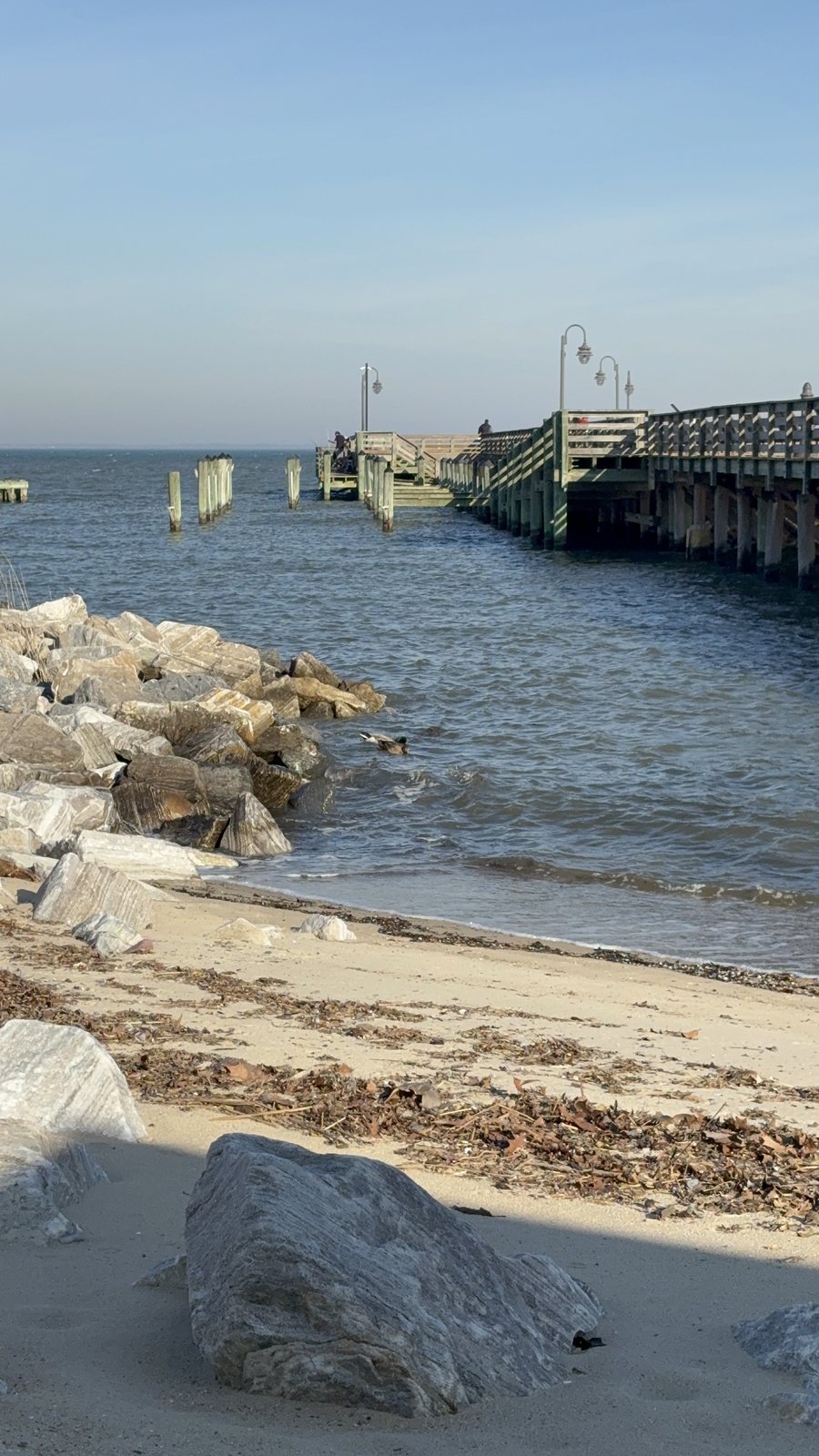
What’s left is half a mile of boardwalk with a bike path, seven blocks of waterfront, a public fishing pier, and in the off season, almost nobody. I’d argue that’s an upgrade.

Why is the off season the better trip?
The off season at North Beach gives you three things summer can’t: an empty boardwalk, beach access for your dog, and the storm erosion that actually uncovers fossils. Every reason people skip the Chesapeake in winter is a reason to go.
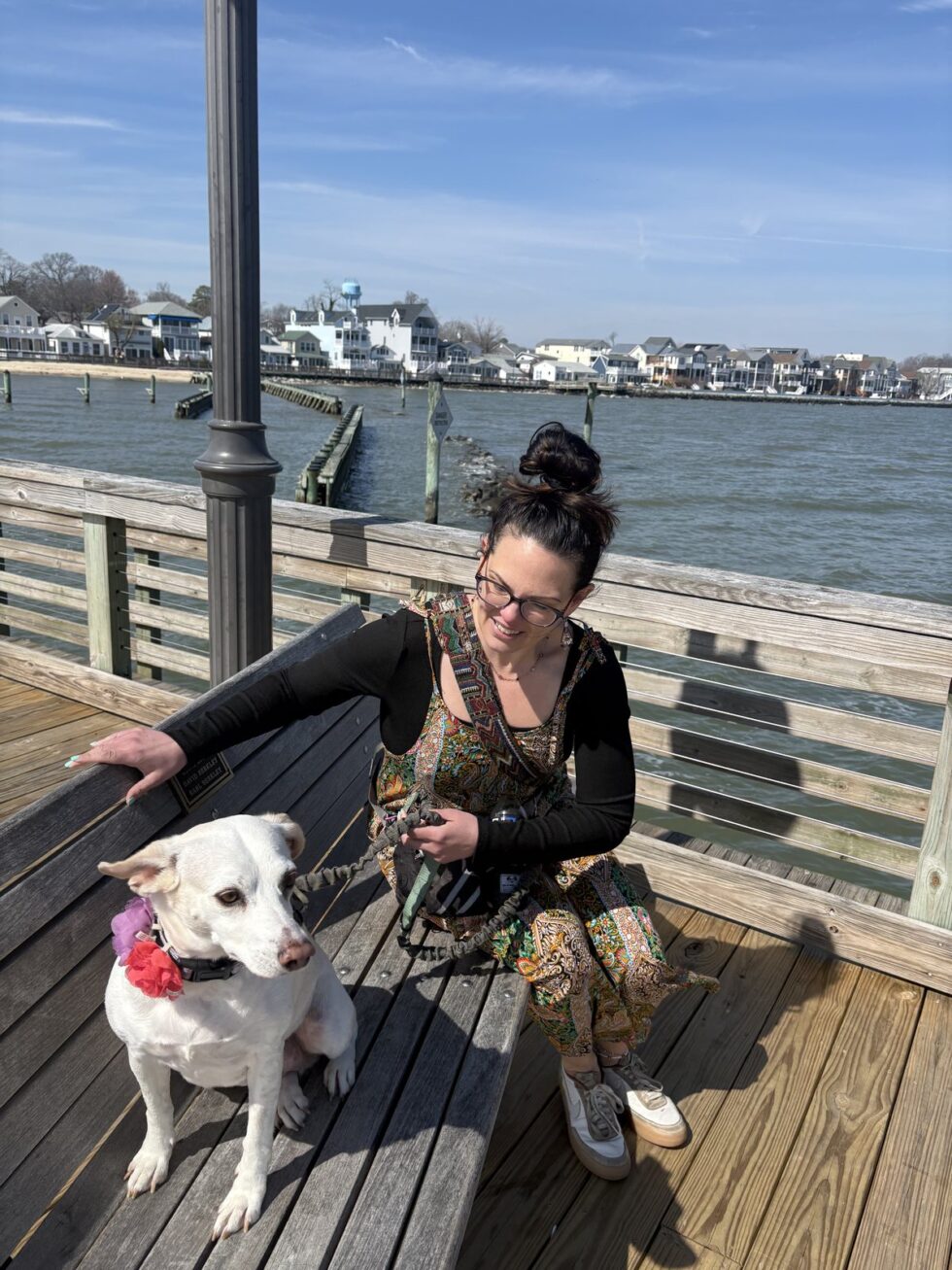
I went on a Sunday in March with my friend Sara. North Beach is roughly the halfway point between my parents’ house and where Sara lives, which is why we ended up there at all. She brought Sori, a Mexican dog she adopted from me a few years ago who now lives a very different life in Maryland. We had long stretches of the boardwalk to ourselves. Same water, same view, no parking problem, no fee.
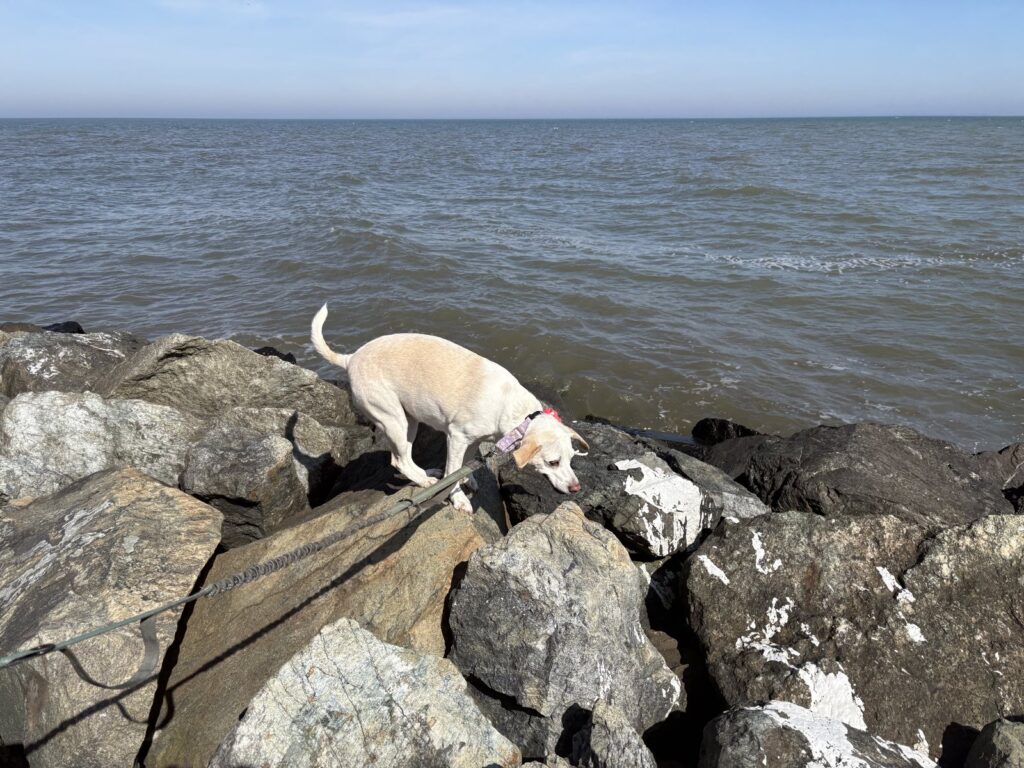
Sori did the sand first and then found the rock breakwater, and that was the next half hour: nose down, picking her way boulder to boulder, completely absorbed. I have about two dozen photos of her doing exactly that and I regret none of them.
Finding shark teeth on the Chesapeake
Fossil shark teeth wash into the beach gravel along this coast because you’re at the edge of the Calvert Cliffs, one of the most productive Miocene fossil zones on the East Coast. Ten to twenty million years ago this was a warm, shallow sea full of sharks, rays, whales and crocodilians. The cliffs erode, and what erodes out ends up at the waterline.
Over 600 fossil species have been identified from these deposits. The teeth you’re most likely to turn up are sand tiger, mako, tiger, hammerhead, snaggletooth and lemon shark. Megalodon happens, rarely, and it’s the one everybody’s actually hoping for.
Timing matters more than patience here. Erosion is what exposes fresh teeth, and winter is when the storms do the eroding, so a cold morning at low tide a day or two after rough weather beats a warm afternoon on a beach that fifty people already walked.
How to actually find them
- Go at low tide, ideally early in the day, ideally after a storm
- Work the strand line, the debris line where the tide drops shell hash and gravel
- Look for dark brown or black, and look for shine. The teeth are glossier than the shells around them
- A small scoop or sifter lets you work deposited gravel instead of digging
- Never dig into the cliffs. It’s prohibited and it’s a real landslide risk
If fossils are the main reason for your trip, North Beach is a fine start but not the strongest site in the county. Bayfront Park in Chesapeake Beach is one mile south and has the local reputation. Breezy Point, Flag Ponds Nature Park and Matoaka Beach are the other names worth knowing.
The oyster reef next door
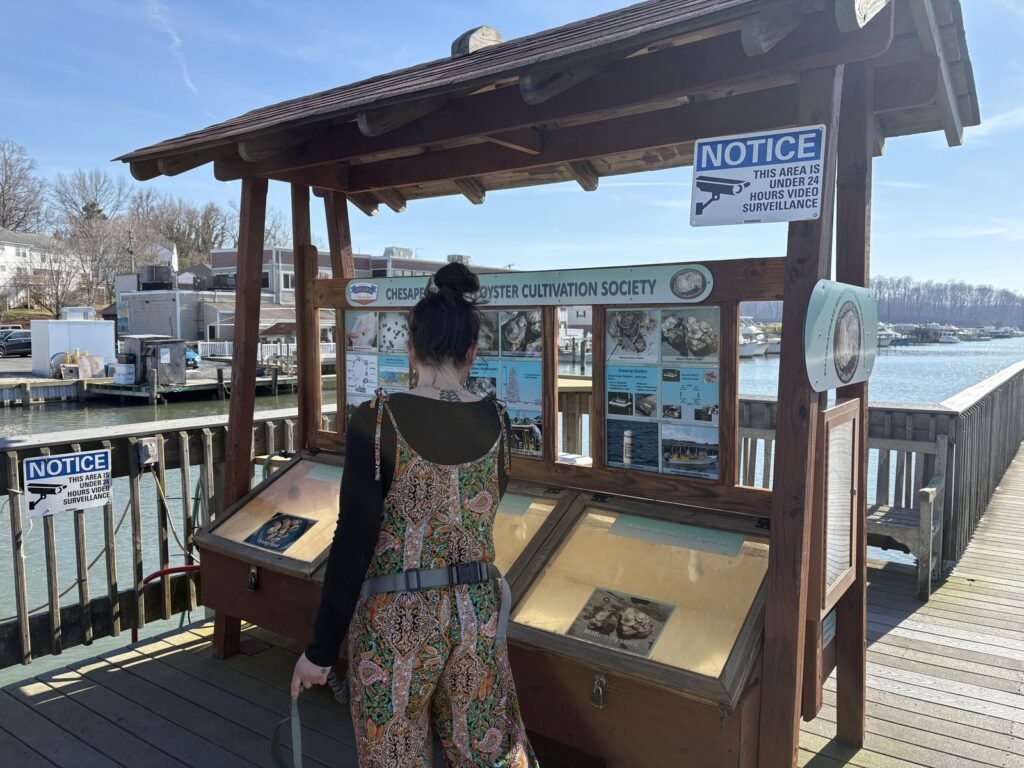
One mile south in Chesapeake Beach there’s a display shelter on the water run by the Chesapeake Beach Oyster Cultivation Society, and it’s worth the ten minute detour. We found it on the pier: two glass cases showing oyster spat alongside mature oysters three to fifteen years old, and panels walking through how the whole thing works.
CBOCS was founded in 2011 by John Bacon and the Town of Chesapeake Beach, working with Maryland’s Department of Natural Resources through its Maryland Grows Oysters program. Roughly 125 community volunteers have spent the years since reviving the Old Rock Reef, depositing oyster yearlings on the sanctuary each year so they grow, reproduce and sustain a wild population. The reef gives crabs, mussels, fish and eels somewhere to live, and the oysters filter the water while they’re at it.
It’s also become a teaching site. Every fifth grade class in Calvert County Public Schools comes to Fishing Creek to study oyster habitats and life cycles through the Chespax program, and more than 10,000 students have been through it. The display shelter sits at the start of the trail behind the Chesapeake Beach Water Park.
I liked the symmetry of it. You spend the morning picking 20 million year old teeth out of the gravel, which is the Bay handing you something, and then you walk past a case of three year old oysters that volunteers are putting back.
Can you bring a dog to North Beach?
Leashed dogs are welcome on the North Beach boardwalk, and beach access for dogs is seasonal rather than year round. In summer the beach is off limits to them. In the off season they can get onto the sand, which is one of the better arguments for a winter trip.
Rules do change season to season and the posted summer rule is strict, so check the town’s current notice before you go rather than trusting a blog post from March.
Where do you park, and what does it cost?
North Beach has two town-owned parking lots near the beach and boardwalk, one privately owned paid lot, and on-street parking with restrictions that catch a lot of first-time visitors out. The single rule worth memorizing before you arrive: all parking west of Chesapeake Avenue is resident only.
The town marks public parking areas with yellow stars, so look for those rather than assuming an empty curb is fair game. On-street spots that are open to visitors often carry time limits of 15 minutes, 30 minutes or 2 hours, which is fine for the boardwalk and the museum but not for a full beach day.
On cost, I’d rather tell you the truth than a number I can’t stand behind: the town doesn’t publish its lot rates or permit prices online. Nothing on the official parking page lists an hourly, daily or seasonal figure. If you need to know before you drive, call the town office on 301-855-6681, Monday to Friday, 8:30am to 4:30pm. They’re at 8916 Chesapeake Avenue.
Practically speaking, this matters far less on the trip I’m recommending. Parking pressure at North Beach is a summer problem. On a Sunday in March we parked without thinking about it, which is roughly the theme of this entire article.

Practical details: fees, pier, museum, food
North Beach charges for beach access in season and nothing off season, which is the short version of this whole article. Here’s what you need for the trip.
- Beach fees, in season: $9 for Calvert County residents aged 12 to 54, $25 for out of county visitors, free for children two and under. Season passes and senior and military rates are available.
- Fishing pier: public, and you’ll need a valid Maryland state fishing license.
- Getting there: roughly thirty miles south of Annapolis, one mile north of Chesapeake Beach. An easy day trip from Washington or Baltimore, which is exactly what it was built to be.
- Farmers market: May through October, running in some form since 1926. If a market is what you want, that’s a summer trip, not this one.
- Bayside History Museum, 4020 4th Street: the twin beaches, the amusement park at Chesapeake Beach, Camp Roosevelt and the resort era. Group tours by arrangement, 410-610-5970.
- Food: The Westlawn Inn, Hook and Vine, Baia for brunch with a water view, Chesapeake Bounty for local produce and seafood, and Plaza Mexico.
- Soft serve: I had pineapple soft serve for the first time in my life here, in March, on the Chesapeake Bay. I recommend it and I won’t be defending this position.
Common questions
Is North Beach, Maryland worth visiting?
Yes, particularly outside the summer season. You get a half mile boardwalk on the Chesapeake Bay, a public fishing pier, fossil hunting in the beach gravel, and in the off season, almost no other people. It’s a half day rather than a weekend, and it pairs well with Chesapeake Beach a mile south.
What’s the difference between North Beach and Chesapeake Beach?
They’re two separate towns one mile apart, often called the Twin Beaches. Chesapeake Beach is the one Otto Mears built as the rail resort with the amusement park. North Beach was platted alongside it in 1900 as “North Chesapeake Beach.” Today Chesapeake Beach has Bayfront Park, which is the stronger fossil hunting spot of the two.
When is the best time to look for shark teeth in Maryland?
Low tide, early in the morning, one or two days after a storm, and preferably in winter. Storm erosion is what pulls fresh material out of the Calvert Cliffs and drops it at the waterline. Calm summer weather leaves you working a beach that’s already been picked over by the day’s visitors.
How old are the shark teeth found on the Chesapeake Bay?
Roughly 10 to 20 million years old, from the Miocene epoch, when southern Maryland was covered by a warm, shallow sea. The Calvert Cliffs deposits have yielded over 600 identified fossil species, from shark and ray teeth through marine mammals, turtles and crocodilians.
Do you need a permit to collect fossils there?
Beachcombing for loose fossils below the high tide line on public beaches doesn’t require a permit, and it’s the safest and most productive way to collect. Digging into the cliffs themselves is a different matter: it’s prohibited and dangerous because of landslide risk. Collect what the water already brought you.
Planning a Chesapeake trip and want someone else to do the legwork? My Travel Concierge Service helps you build a trip that actually fits how you like to travel, whether that is outdoor days, cultural stops, or the quiet off season version of a place. For more practical guides and insider tips, join the newsletter.
Start exploring with: Snow, Home, and Slowing Down: A Different Kind of Update from Maryland
More from the same stretch: When Travel Pauses: A Real-Life Digital Nomad Story from March
If you would rather be in the mountains: Hiking La Eme in Chipinque and Pico Horcones in La Huasteca




0 Comments